
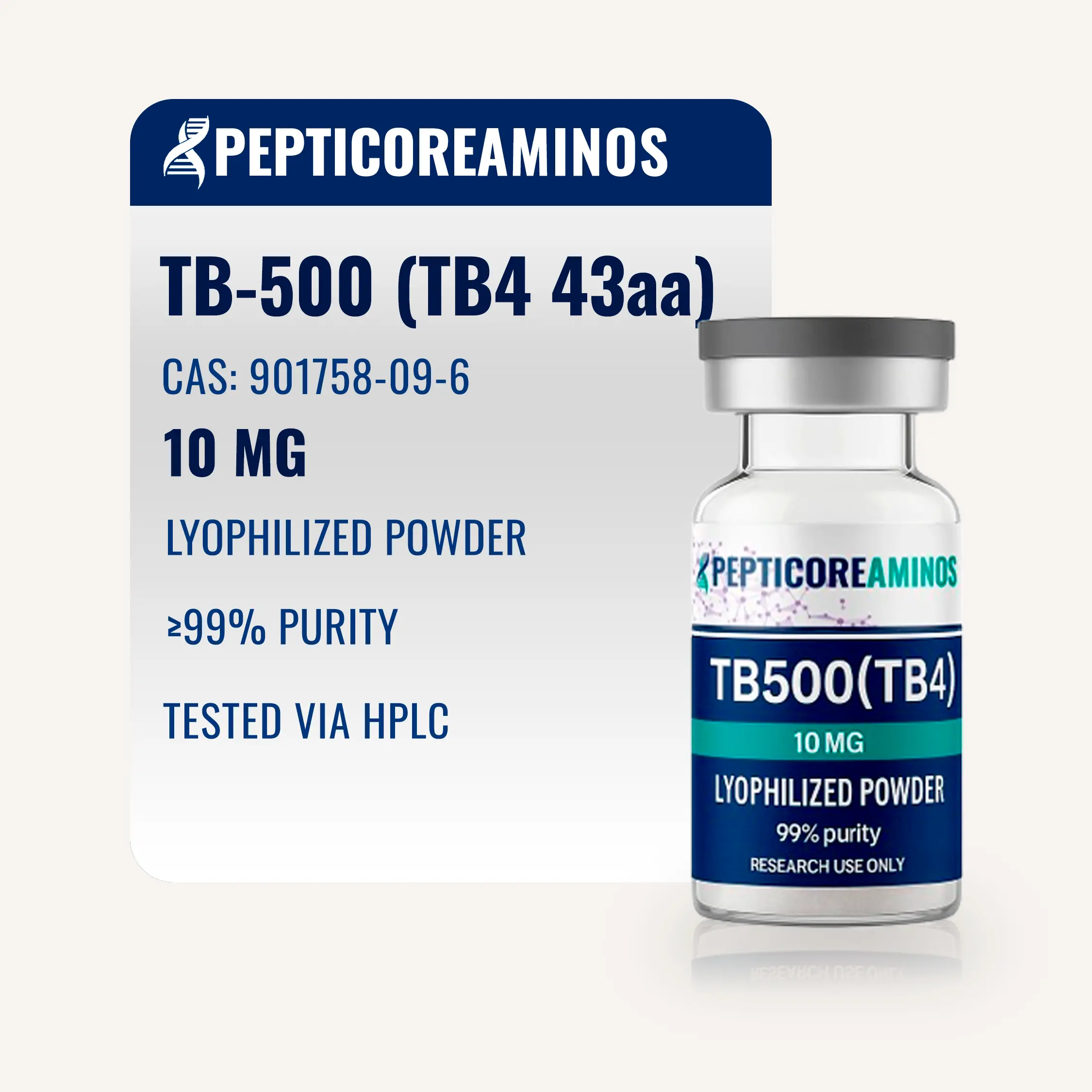



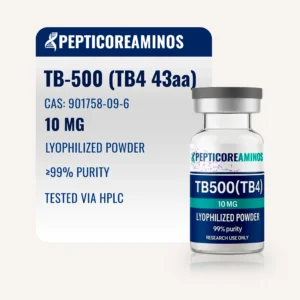
TB-500
Synthetic 43-amino-acid peptide studied in biological, biochemical, and cellular research.
Introduction
TB-500 is a synthetic peptide composed of 43 amino acids, corresponding to the sequence motif of thymosin beta-4 (Tβ4), which has been extensively studied in cytoskeleton biology. In experimental systems, peptides of the beta-thymosin family are used to investigate mechanisms of monomeric actin (G-actin) sequestration, actin filament (F-actin) dynamics, and cellular processes dependent on cytoskeletal remodeling.
Numerous experimental models have examined the role of these molecules in phenomena such as cell migration, stress fiber organization, neurite outgrowth, endothelial cell behavior, and extracellular matrix (ECM) remodeling. Preclinical literature reports studies conducted in cell cultures and animal models in which molecular, biochemical, and histological parameters related to tissue remodeling processes and cellular responses to stress are evaluated.
Biochemical Characteristics
- Sequence Ac-Ser-Asp-Lys-Pro-Asp-Met-Ala-Glu-Ile-Glu-Lys-Phe-Asp-Lys-Ser-Lys-Leu-Lys-Lys-Thr-Glu-Thr-Gln-Glu-Lys-Asn-Pro-Leu-Pro-Ser-Lys-Glu-Thr-Ile-Glu-Gln-Glu-Lys-Gln-Ala-Gly-Glu-Ser
- Molecular formula: C212H350N56O78S
- Molar mass: 4963.4408 g/mol
- CAS number: 77591-33-4
- PubChem CID: 16132341
The peptide structure has been characterized in biochemical studies through spectrometric analyses and high-resolution purification techniques. The complete sequence enables molecular interaction studies with cytoskeletal components in controlled experimental environments.
Experimental Research Contexts
TB-500 is used in research protocols aimed at studying cytoskeleton-dependent cellular phenotypes and evaluating signaling pathways associated with actin dynamics. Among the experimental contexts reported in the literature are:
- Analysis of actin dynamics (G-actin/F-actin state, stress fiber organization)
- Evaluation of cell migration and adhesion mechanisms
- Studies on endothelial models and angiogenic transcriptional programs
- Analysis of oxidative stress response pathways in controlled cellular systems
- Preclinical neural models with morphological and molecular evaluation
- Paradigmi sperimentali in modelli animali con analisi quantitative di parametri istologici e biochimici
The observed results are strongly dependent on the model used, the dosage, the experimental route of administration, and the selected analytical parameters.
Mechanistic Context
Peptides of the beta-thymosin family are traditionally described as monomeric actin-binding factors, influencing the availability of monomers for filament assembly. Since the polymerization state of actin regulates processes such as membrane protrusion, endocytosis, cytokinesis, and mechanotransduction, modulation of the G-actin/F-actin balance may alter cellular behaviors associated with cytoskeletal remodeling.
In various preclinical models, the literature reports modifications in molecular markers associated with angiogenic transcriptional programs, extracellular matrix remodeling, and cellular stress response pathways.
Summary of Preclinical Literature
The available scientific literature describes the experimental use of peptides related to thymosin beta-4 in neural, vascular, cutaneous, infectious, and cardiovascular models. Studies include histological assessments, analyses of molecular markers, measurements of inflammatory mediators, and functional parameters specific to the model used.
The interpretation of results must always be contextualized within the specific experimental design, taking into account laboratory conditions, controls, dosages, and exposure times.


Reviews
There are no reviews yet.